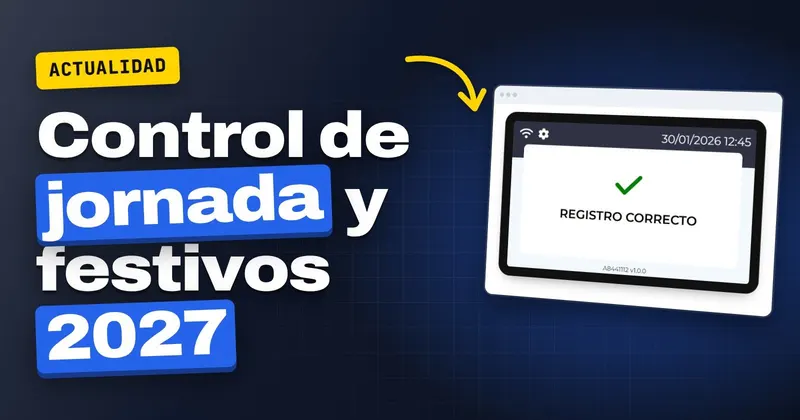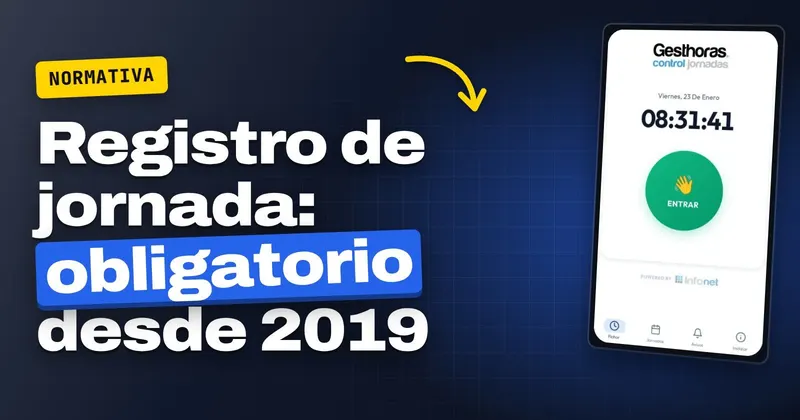
Someone new joins the admin team, sees the folder of clock-in and clock-out sheets and asks whether this clocking-in business is something recent. The short answer: the working time record has been mandatory since 12/05/2019 for every company with employees, and the underlying rule has not changed. Below you will find the rule and its date, who it applies to, what fines the law provides for and where the digital record stands.
Since when is the working time record mandatory
The obligation was introduced by Article 10 of Real Decreto-ley 8/2019, of 08/03/2019 (a Spanish royal decree-law on urgent measures). That article added paragraph 9 to Article 34 of the Estatuto de los Trabajadores (Spain's Workers' Statute, the core employment law). It came into force on 12/05/2019 and is still in force: the consolidated text of the Statute was updated on 03/10/2026 and that paragraph was left as it was.
Since that date, any SME with staff has had to be able to show what time each person started and what time they finished, every day. There is no adaptation period still pending. A workshop with three mechanics and a shop with two sales assistants have exactly the same obligation.
What Article 34.9 of the Statute requires
According to the article, "the company shall guarantee the daily working time record, which must include the specific start and finish times of each worker's working day". Three requirements follow from this:
- A daily, individual record: each person's start time and finish time, every day.
- A way of organising it agreed in the collective agreement or in a company agreement. If there is none, the company decides after consulting the employee representatives.
- Retention for four years, available to workers, their representatives and the Inspección de Trabajo (the Spanish Labour Inspectorate).
Four years of signed, ordered sheets that can be found the day someone asks for them: that last point is the one that weighs most when the record is kept on paper. The page on the working time record puts it into practice, and the most common questions about the working time control law are in the FAQ.
Who it applies to and who it doesn't
Recording working time is an obligation of the company towards its employees. The Ministry of Labour guide of 13/05/2019, which is advisory and has no status as a legal rule, makes clear that it also covers people who work away from the workplace.
| Case | Must their working time be recorded? | Source |
|---|---|---|
| Staff in the office, workshop, warehouse or shop | Yes, daily start and finish | Art. 34.9 ET |
| Sales reps and mobile staff | Yes | Ministry guide |
| Temporary contracts | Yes | Ministry guide |
| Remote working | Yes, with start and end of the working day | Art. 14 of Ley 10/2021 |
| Part-time | Yes, day by day and with a monthly total | Art. 12.4.c ET |
| Self-employed with no employees | No | Art. 1 ET (scope) |
There is a specific rule for remote working: Article 14 of Ley 10/2021 (Spain's remote working law) requires the record to reflect "faithfully the time" spent on work, with the moment it starts and finishes. The post on the working time record for remote work covers it in more detail.
Part-time and overtime: two records with their own rules
For part-time contracts, Article 12.4.c of the Statute says that working time "shall be recorded day by day and totalled monthly", with a copy given to the person along with the payslip. The monthly summaries are also kept for four years. If the record fails, the law presumes the contract is full-time, unless proven otherwise. You will find the details in what to record in part-time contracts.
For overtime, Article 35.5 applies: a day-by-day record, a total for the pay period and a copy of the summary with the payslip. The maximum remains 80 hours of overtime a year (Art. 35.2). How to give it back as time off or as pay is covered in how overtime is compensated.
What happens if you don't keep the record
Breaching the rules on working time, overtime, additional hours, rest periods and the "working time record" is a serious infringement under Article 7.5 of the Ley sobre Infracciones y Sanciones en el Orden Social (LISOS, the Spanish law on social-order infringements and penalties; Real Decreto Legislativo 5/2000). The amounts are in Article 40.1.b:
| Grade | Fine per infringement |
|---|---|
| Minimum | €751 to €1,500 |
| Medium | €1,501 to €3,750 |
| Maximum | €3,751 to €7,500 |
Beware of a detail that often gets repeated wrongly: fines are imposed per infringement, not per worker. What the Inspectorate looks at when it arrives is covered in what the Labour Inspectorate checks in working time control.
If your record today is signed sheets or an Excel file that only one person understands, Gesthoras stores every clock-in and clock-out from a mobile, a computer, a QR code or the RecLog terminal with NFC key fob, and produces reports for the Inspectorate in PDF and Excel. Ask for information and we will show you what your team's record would look like.
What about the digital working time record
The Ministry of Labour has prepared a draft royal decree developing Article 34 of the Statute. It is a draft still going through the process, so it is worth separating what the draft says from what is binding today.
According to the draft, the record would become digital, traceable and tamper-proof, and the rule would come into force 20 days after publication in the BOE (Spain's Official State Gazette). Until it is published, what is binding is Article 34.9 of the Statute, and the final text may change.
Before changing anything because of that rule, check that it has actually been published in the BOE. What the draft contains and how to prepare without waiting is covered in digital working time record: what changes and what stays the same. The maximum working day, meanwhile, remains 40 hours a week of actual work on average over the year (Art. 34.1 of the Statute).
Are paper or Excel still valid?
Today, yes. The law accepts any system that guarantees the daily record: paper, spreadsheet or software. There is also no official approval scheme for working time record software. If you are still on paper, the daily working time record template in PDF gives you the format; if you are on Excel, the comparison of working hours control in a spreadsheet and with Gesthoras shows you where it tends to break down.
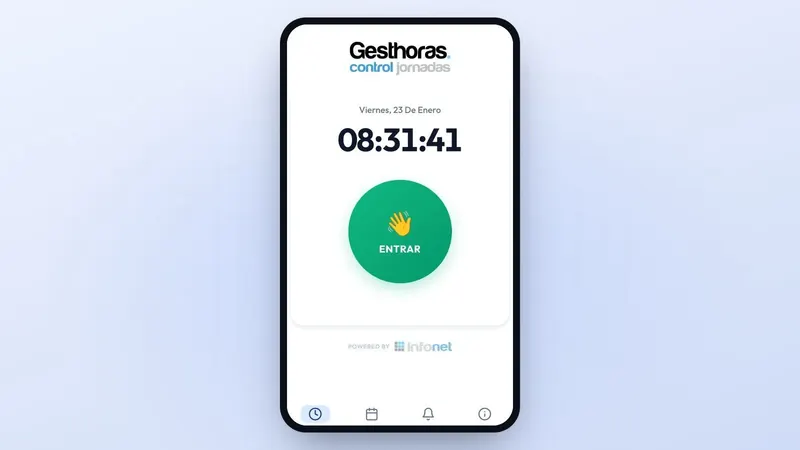
Paper works fine until someone leaves without clocking out or a month's sheet goes missing. In Gesthoras each person clocks in with their personal link from their mobile: they tap ENTRAR (IN) at the start and SALIR (OUT) at the end. If they forget, the working day closes automatically at the time you have set, and that time can be changed.
What to do now with your working time record
- Check that you have each person's start and finish times, every day, and that you can show the last four years.
- Review separately anyone on a part-time contract or working overtime: monthly total and a copy with the payslip.
- Decide whether to stay with paper or Excel until the digital record reaches the BOE, or to prepare now.
Do you want to move from sheets to a record kept from a mobile, a computer or a terminal at the door? Ask how Gesthoras adapts to your team. You can also start free, with no card, with 1 employee to try it out.