A rush delivery, an absence to cover, the month-end close: overtime crops up in almost every business. The problem is rarely working the extra hours, but not knowing how many are worked, not recording them the same way for everyone and reaching the end of the year without knowing whether the limit has been exceeded. This article explains what counts as an overtime hour, how it is compensated and what you need to record so there are no surprises.
What is an overtime hour
Under article 35.1 of the Estatuto de los Trabajadores (Spain's Workers' Statute), overtime hours are those worked above the maximum length of the ordinary working day. That ordinary working day is set by the collective agreement or the contract, within the limits of article 34.
Two details to bear in mind:
- If your company has an agreed irregular distribution of working hours, working more hours on a given day does not automatically mean they are overtime: you need to check the calculation set out in the collective agreement or the arrangement.
- Working overtime is voluntary, unless it has been agreed in a collective agreement or individual contract, within the legal limits.
How many can be worked
Article 35.2 sets a maximum of eighty overtime hours a year. There are some important nuances:
- If the contract has an annual working time lower than the company's standard, the maximum is reduced proportionally.
- Overtime hours compensated with time off within the four months following the time they were worked do not count towards that limit.
- Under article 35.3, hours worked to prevent or repair accidents and other extraordinary and urgent damage do not count towards the limit either, although they are compensated as overtime.
Remember too that people on part-time contracts cannot work overtime, except in the cases covered by article 35.3. Hours they work above their agreed hours are additional hours, which have their own rules.
Paying for it or compensating with time off
The collective agreement or, failing that, the individual contract decides between two options:
| Option | Rule | What to watch |
|---|---|---|
| Payment | The amount cannot be lower than the value of an ordinary hour | That they appear on the payslip for the month in which they were worked |
| Paid time off | An equivalent amount of rest time | That it is taken within the deadline and recorded |
| No agreement | Compensated with time off within the following four months | Keep a tally for each person so the deadline is not missed |
Compensating with time off has a practical advantage: if it is taken within those four months, those hours do not use up the eighty-hour limit. But it requires keeping a good record of what is owed to each person and when it is repaid.
What you need to record
In addition to the daily working time record required by article 34.9, article 35.5 adds a specific obligation for calculating overtime: each person's working day is recorded day by day and totalled over the period set for paying wages, with a copy of the summary given to the worker with the corresponding payslip.
In practice, that means:
- Actual daily record. Start and finish time for each day. Without it, overtime cannot be calculated.
- Totals by pay period. Usually the month. The sum of hours worked compared with those of the ordinary working day.
- Summary for the worker. A copy together with the payslip.
- Annual tally. The overtime hours accumulated by each person during the year, so the maximum is not exceeded.
- Monitoring of compensation. If compensated with time off, when the hours were worked, when they are repaid and whether the deadline has been met.
Failing to respect the overtime limits or the recording obligations is a serious infringement under article 7.5 of the Ley sobre Infracciones y Sanciones en el Orden Social (Spain's Law on Infringements and Penalties in the Social Order).
Common mistakes
- Recording the theoretical timetable. If the record always shows the same finish time, overtime appears nowhere, even when it is worked.
- Uncontrolled banks of hours. A "I'll give them back to you later" with no date or record ends in disagreements and time off taken outside the deadline.
- Not providing the summary with the payslip. It is an express obligation under article 35.5.
- Asking part-time workers for overtime. Apart from the cases in article 35.3, they cannot work it.
- Looking only at the month. The limit is annual; without a running tally it is easy to go over without realising.
An example of doing it properly
Imagine a workshop with eight people and a collective agreement that sets compensation of overtime with time off. An urgent order means extending the working day for several days in a row. Each person clocks out at their actual finish time, so the record reflects the extra hours. At the end of the month each person's hours are totalled, the summary is handed over with the payslip and rest days are agreed to repay them before four months have passed. If someone cannot take them within the deadline, there is time to check whether they need to be paid, according to what the collective agreement provides. Nobody has to reconstruct anything from memory.
How Gesthoras helps
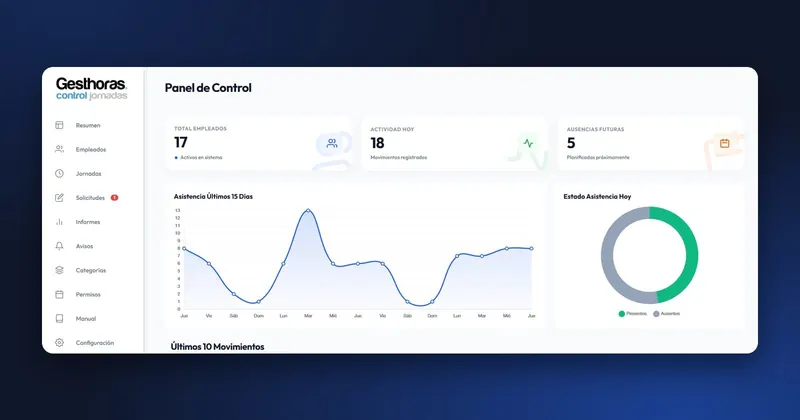
The basis of any overtime calculation is a reliable record of clock-ins and clock-outs. In Gesthoras, each person clocks in at the start and out at the end from their mobile, computer, a QR code or the RecLog terminal, and the hours for each day are calculated automatically from the clockings, with no formulas that break. Each employee sees their working days with the hours worked, and the company generates whatever working time reports it needs, including for the Inspección de Trabajo (Spain's Labour Inspectorate).
If you currently keep hours in a spreadsheet, in the comparison between Excel and Gesthoras you will see what changes, and in mandatory working time record you have a summary of what the law requires.