Since 2025 there has been talk of a new digital working time record, and many companies don't know whether they already have to change their clock-in system. The short answer: at the date of this article, no rule imposing a digital record has been published in the BOE (Spain's Official State Gazette), so the obligation in force is the same as ever. But the reform is under way, and it's worth knowing what it aims to change, what will stay the same and what you can do now so you aren't caught out when it arrives.
What is in force today
The obligation to record working time is set out in article 34.9 of the Estatuto de los Trabajadores (Spain's Workers' Statute), introduced by Real Decreto-ley 8/2019 (Royal Decree-law 8/2019). It applies to all companies, whatever their size or sector, and requires:
- A daily record of each employee's working time.
- That it shows the exact start and finish times, without prejudice to any flexible working hours in place.
- That it is organised through collective bargaining or a company agreement or, failing that, by decision of the company after consulting the employees' legal representatives.
- That it is kept for four years and made available to employees, their representatives and the Inspección de Trabajo y Seguridad Social (Spain's Labour and Social Security Inspectorate).
The current text does not require any specific method: it doesn't say the record has to be digital, nor does it prohibit paper. What does matter is that the record is reliable, reflects actual working time and can be consulted when requested. Failing to meet the working time record obligations is a serious offence under article 7.5 of the Ley sobre Infracciones y Sanciones en el Orden Social (Spain's Law on Infringements and Sanctions in the Social Order).
Where the reform stands
In 2025 the Ministerio de Trabajo y Economía Social (Spain's Ministry of Labour and Social Economy) put a draft royal decree on the working time record out for public consultation. According to the explanatory report accompanying the draft, the Government is processing it under the authority granted by article 34.7 of the Statute, which allows it to set specific rules for the working time record, and the text proposes a record that is objective, reliable and accessible.
What matters for your company:
- It has not been approved or published. At the date of this article, the royal decree does not appear in the BOE. Until it is published, it is not enforceable.
- The text may change. A draft goes through reports and revisions before it is approved. What the press has reported about its content may not match the final version.
- There is no firm date. The adaptation period companies will have is not yet known either. Don't trust dates that don't come from the BOE or official sources.
When it is published, the sensible thing is to read the final text, check from when it applies and review your system with your employment adviser.
What is likely to change and what stays the same
With the caveat that the text is not final, the direction of the draft is clear: to move from a record that can be kept in any way to a digital one, harder to tamper with and easier to consult, including by the Inspectorate. The table summarises the difference between what is certain today and what depends on the final version.
| Aspect | Today (article 34.9) | With the reform |
|---|---|---|
| Daily record of start and finish | Mandatory | Remains the basis |
| Recording method | No specific method set | Proposed to be digital; depends on the final text |
| Retention | Four years | Pending the final text |
| Access for staff, representatives and the Inspectorate | Mandatory when requested | More direct access proposed; pending the final text |
| Reliability of the record | Required in practice | Proposed as an express requirement: objective, reliable and accessible |
What will not change, however the royal decree turns out, is the purpose of the record: to make it possible to know how many hours each person really works, and to ensure that data can't be reworked to suit.
What you can do now
Waiting for the BOE before acting tends to be costly: introducing a new system, training staff and consulting representatives all take time. These steps work under the current rules and leave you prepared for the new ones:
- Review how you record time today. If the record depends on someone writing it up neatly at the end of the week, it doesn't reflect the actual working day. That is the first weakness to fix.
- Check that each person records their own working time. A record filled in by a manager for the whole team is harder to defend than one where everyone clocks in and out themselves.
- Make sure records are retained. Four years of records in folders, loose sheets or different versions of a file are hard to pull together. Keep a single, orderly place for them.
- Prepare access. Think about how you would hand over the records if an employee, their representative or the Inspectorate asked for them tomorrow.
- Document how the record is organised. If the company decided it, keep evidence of the consultation with the legal representatives. If it is regulated by your collective agreement or a company agreement, keep that regulation to hand.
- Choose a system that supports several ways of clocking in. Not all roles are the same: someone in an office, someone working on the road and someone coming in through a workshop door may need different solutions.
Common mistakes while the rule is on its way
- Thinking that, because it isn't approved, nothing needs to be recorded. Recording has been mandatory since 2019.
- Buying blindly "the system the new law requires". Until the text is published, nobody can tell you what specific technical requirements it will have.
- Taking dates or fines circulating online at face value. If they don't come from the BOE or an official source, treat them as rumours.
- Confusing a timetable with a record. Having the company's working hours posted on the wall is not recording working time: you have to log what each person does every day.
How Gesthoras helps
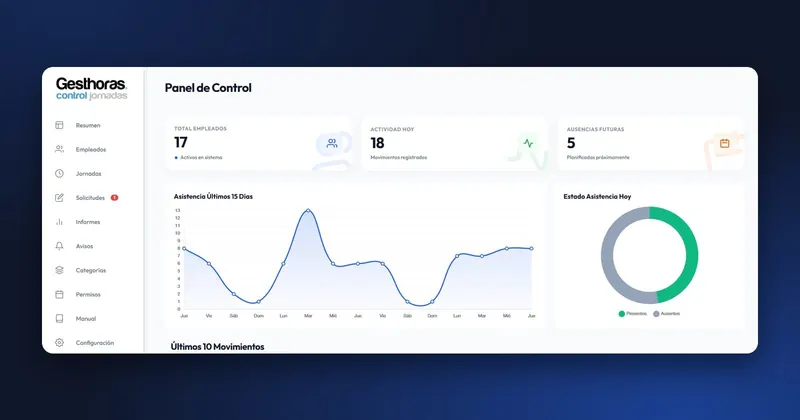
Gesthoras is a digital working time record: each person clocks in and out from their mobile, their computer, a QR code or the RecLog terminal with an NFC key fob, and the clocking is recorded instantly. Working days are synchronised in real time, kept for the four years the law requires, and the application generates working time reports for the Inspección de Trabajo. Each person can review their own working days, with the hours for each day.
If you currently track time in a spreadsheet, the comparison between Excel and Gesthoras sets out the differences point by point, and mandatory working time record explains how the application meets the current obligation.