The working time record logs when each person's day starts and ends, but between those two times there are breaks: a mid-morning snack, lunch, a break in the afternoon. If you don't know which ones count as work and which don't, the hours in the record won't match the hours actually worked, and that ends in disputes over overtime or problems with the Labour Inspectorate. Here is what the rules say, how to decide which breaks to record and how to do it without complicating day-to-day work.
Which breaks are mandatory
The Estatuto de los Trabajadores (Spain's Workers' Statute) sets several minimum rest periods:
- Break during a continuous working day (article 34.4): if the continuous daily working day lasts more than six hours, a rest break of at least fifteen minutes must be provided. For workers under eighteen, the break is at least thirty minutes and applies when the continuous working day exceeds four and a half hours.
- Rest between working days (article 34.3): at least twelve hours must elapse between the end of one working day and the start of the next.
- Weekly rest (article 37.1): a minimum of a day and a half without interruption, which can be accumulated over periods of up to fourteen days. Workers under eighteen get at least two days without interruption.
Your collective agreement may improve on these minimums or specify how they are taken. Read it before designing how you record breaks, because many of the answers are there.
When a break counts as working time
This is the key question. Article 34.4 says that the break in a continuous working day is considered effective working time when the collective agreement or the employment contract says so. If neither does, it doesn't count.
As for other breaks, those that aren't mandatory and are taken at the worker's own initiative or because of the company's organisation, they usually don't count as effective work unless the collective agreement, an agreement or company practice says otherwise. The guide on working time records published by the Ministry of Labour in 2019 already warned that the time between clocking in and clocking out is not, on its own, effective working time, and recommended that the recording system allow these breaks to be assessed.
| Type of break | Counts as effective work? | Where to check |
|---|---|---|
| Break in a continuous working day of more than six hours | Only if the collective agreement or contract says so | Article 34.4 of the Workers' Statute and your collective agreement |
| Lunch in a split working day | Normally not: it separates two blocks of work | Your collective agreement and your work calendar |
| Short, non-mandatory breaks | Depends on what has been agreed or on company practice | Collective agreement, company agreement or contract |
| Breaks for reasons specific to the job | Depends on the applicable rules or collective agreement | Sector regulations and collective agreement |
Do you have to record breaks?
The minimum obligation under article 34.9 is to record the start and end time of the working day every day. The law does not expressly require clocking each break. Technical criterion 101/2019 of the Inspección de Trabajo (Spain's Labour Inspectorate) accepts that collective bargaining or a company agreement may provide for breaks to be recorded, provided that the record always includes the start and end times.
That said, the fact that it isn't mandatory doesn't mean it isn't advisable. If there is an hour's lunch between clocking in and out that isn't worked and isn't reflected anywhere, the record will say that person worked an hour more than they really did. When someone claims overtime or the Inspectorate reviews the hours, you will have to explain that difference with more than the company's word.
There are two usual ways to solve it:
- Clock the longer breaks. For example, in a split working day, clock out for lunch and clock back in. The record shows exactly the blocks worked.
- Set breaks by agreement. If the break is always the same, the collective agreement or a company agreement can set its length and whether it counts. The record captures the start and end, and the break is deducted as agreed.
The first is more precise; the second is simpler. What matters is that the choice is in writing and that the workforce knows about it.
Common mistakes with breaks
- Saying nothing about the snack break. Then everyone understands something different about whether it counts.
- Deducting breaks nobody has taken. If the record subtracts an hour for lunch from someone who ate in ten minutes at their workstation, the data isn't real.
- Forgetting the mandatory break on long days. On continuous working days of more than six hours, the minimum break is not optional.
- Squeezing the rest between working days. Closing late and opening early the next day can leave less than twelve hours between one working day and the next. The record makes it obvious.
- Changing the criterion without notice. If you decide to start clocking breaks, explain it and consult the legal representatives of the workforce beforehand.
Checklist
- You know what your collective agreement says about the break in a continuous working day.
- You have decided which breaks are clocked and which are set by agreement.
- That decision is in writing and has been communicated to the workforce.
- The record lets you check that there are twelve hours between working days.
- The hours that come out of the record match the hours that are paid.
How Gesthoras helps
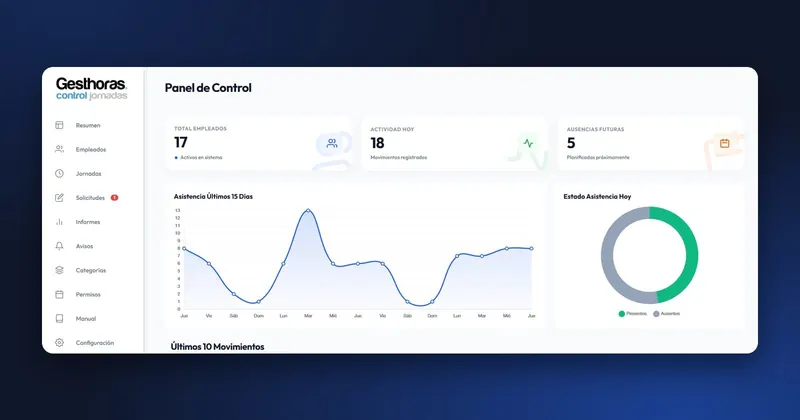
In Gesthoras, each person clocks the start and end of their working day from their mobile, computer, a QR code or the RecLog terminal, and the application calculates each day's hours from those clockings. Each employee can see their working days with the hours worked, which helps to spot straight away if something doesn't add up. The Advanced licence includes attendance control with advanced working day configuration.
Before choosing how to reflect breaks, check what your collective agreement requires and try how it fits your case: you can start for free, with no card needed. You can find a summary of the obligations in mandatory working time record and all the features in Gesthoras features.